Friday, January 20, 2012

SNAPSHOT + THOUGHTSHOT + DIALOGUE = SCENE

Meet the crabs!  


In science, students have been observing, notetaking, and taking care of the crabs.  They set up their habitats on Tuesday and the crabs arrived on Wednesday.


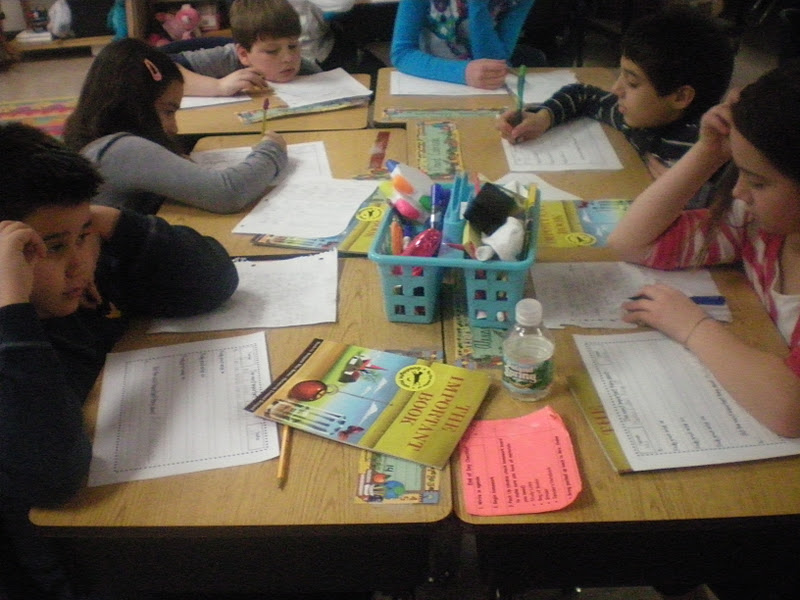
This week, students have been learning about Martin Luther King, Jr. through a video and a read aloud.  While watching the video and listening to Martin's Big Words on the carpet they have been taking notes.  Next, as a class we read The Important Book, since their MLK Jr. writing assignment will follow the same format. 


Students then filled in this graphic organizer.  "The most important thing about Martin Luther King Jr. is . . ."  They also filled in three important details about his life.  The ending of this writing assignment is a loop ending.  Therefore the last line repeats itself, "But the most important thing about Martin Luther King Jr. is . . ." 


During Reading Workshop the young detectives met with their literature discussion group.  


Finally in Writer's Workshop, the class began drafting their story based on the speculative prompt they chose. Using the four-square graphic organizer students began drafting several "scenes" to create a story.  

Students know that a scene is created using this formula: SNAPSHOT + THOUGHTSHOT + DIALOGUE = SCENE. 

A snapshot in writing is "show, don't tell" - a snapshot sentence can be in the form of a simile or metaphor, or can focus on a particular detail. It is a sentence that creates a froze image in your readers' minds. 

A thoughtshot in writing is "tell, don't show" - a thoughtshot sentence brings your readers inside a person's head to share a thought or feeling about a situation.  It is a sentence that can be in the form of a statement or question about the situation.


HAVE A TERRIFIC WEEKEND!


Tuesday, January 17, 2012

Thoughtful Journal Entry

In Writer's Workshop, students were given four speculative writing prompts.  For each prompt they had to create a few possible story ideas.  This was to help them prepare for responding to writing prompts during a timed writing assignment.  They have to quickly think of how the story will unfold.  What exactly will be the problem?  How will you describe the setting?  How will the problem be solved?  How will the story end?  

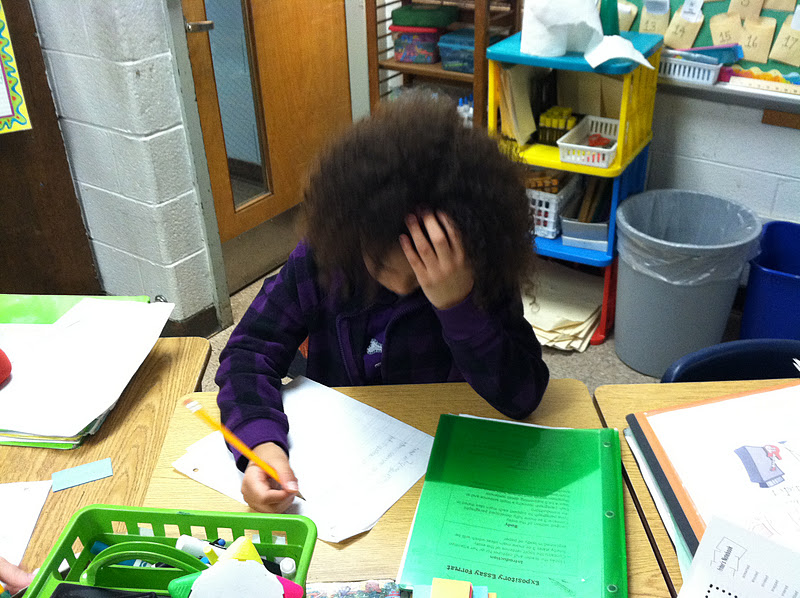
The next day, they opened their notebooks to the page with all of their possible story options.  Each student picked their favorite story and began completing the 4-Square graphic organizer.  (Problem, Turning Point, Solution, Closing).


Now that we are beginning our next genre study (mystery) in Reader's Workshop, students learned how to complete a Thoughtful Journal Entry.  This is building on what they have learned already this year.  Typical reading homework includes reading assigned pages, flagging thoughts (on post-it notes to help novel discussions run smoothly), and completing a journal entry.  Students are allowed to work on this assignment in class if they have time.

Students are already familiar with writing summaries and using strategies as they read.  Now these skills are being rolled into one written assignment. 

Students have been introduced to our expectations, through a minilesson, an anchor chart displayed in the classroom, and each journal entry form includes the expectations.   After students learned about the expectations I showed them an acceptable response I wrote from a short story we read. The response shows a 3-5 sentence summary of what I read.  Next, the second paragraph includes 1-2 sentences of the reading strategy I used and a final sentence that started with one of the conversational moves students have on a bookmark. 

Then it was time for students to try this new format out for themselves.  The class was provided a short story from Chicken Soup for the Kid’s Soul: first paragraph – 3-5 sentence summary; second paragraph – strategy/thinking.  Students referred back to the flagged post-it notes to help them write the second paragraph.

This format allows students to think about a text at a deeper level through: reading independently, flagging their thoughts, writing about their thoughts, and discussing the text. 


During Science, groups gathered around with their notebook and magnifying glass to observe the frogs.